I said at the start of season 1953-54 that Jack had entered most of the competitions he could the previous year, and last year was the same; in fact he could probably have entered even more. He reached the England Amateur Finals in London again and his haul of trophies was even better, with individual honours. He went one better than the previous year by winning the prized trophy of the Yorkshire Billiards Championship, along with the Halifax Snooker Championship. He didn’t fair so well in the Huddersfield Billiards Championship coming in as runner up. He again won 2 team events, the Yorkshire Inter-District Billiards League, for the third time, and the Yorkshire Team Knock-Out Billiards Competition with Oakes WMC. What will this year bring in the way of silverware? Let’s see.
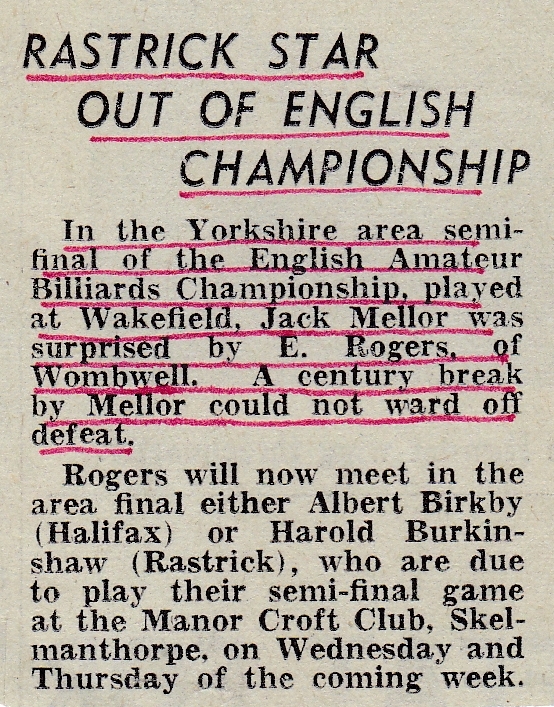
The draw for the Yorkshire Area of the English Amateur Billiards Championship saw Jack get a bye into the semi final, where he would meet E. Rogers of Wombwell whom he had beaten in last years competition at the same stage and venue, Normanton Liberal Club. The match was fairly even on the first night, with Rogers taking a slight lead, but he was more consistent on the second night and, with twenty minutes remaining, led by 200. Jack had more of the running at this point and made a magnificent 111 break, followed by one of 57, but it was too late and he lost by 60. Jack had represented Yorkshire in the previous two years but this year there will be a new face in London as Rogers and the other two semi finalists, Burkinshaw and Birkby have not played in the Championship proper before. Birkby beat Burkinshaw in his semi final and went on to beat Rogers in the final to represent Yorkshire along with Leslie Driffield, the holder, in the Championship proper in London. The Halifax paper seems to get great joy out of Jack’s defeats, as is typified by the report here, probably because they are so few and far apart, especially when their “local” player was doing well.
We do not have any reports of Albert’s venture into the great unknown of the championship proper but next year there is a mention in the Huddersfield Examiner that he was “heavily beaten by Leslie Driffield“. Out of interest, Huddersfield had a representative in the Women’s Amateur Snooker Championship in London, that being Myra Armitage, who played at Fartown Conservative Club. She lost in the second round but put up a good show and her experience will serve her well for the future.
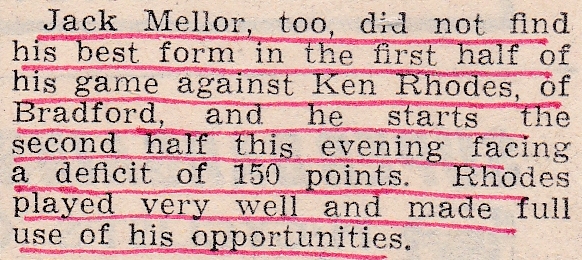
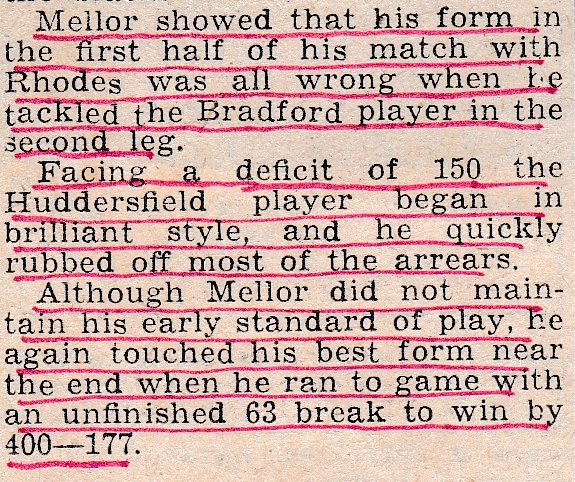
Jack got a bye in the first round of the Yorkshire Billiards Championship along with his Rastrick team mate Jim Broadhead. The second draw with 6 Huddersfield players in it saw Jack drawn against the Bradford policeman, Inspector Ken Rhodes, who he had beaten recently in the Yorkshire League match. The draw only had two Huddersfield players drawn against each other, Burkinshaw and Percival, so we should have a number in the quarter- final. Jack faces a deficit of 150 after his away leg (250 – 400) in Bradford, as he didn’t find his best form and Ken made the most of his opportunities. The second leg saw Jack soon rubbed off the arrears and although he didn’t maintain his early standard of play, he hit good form near the end and ran to game with a 63 unfinished break, to win 400 – 177 on the night and 650 – 577 overall.
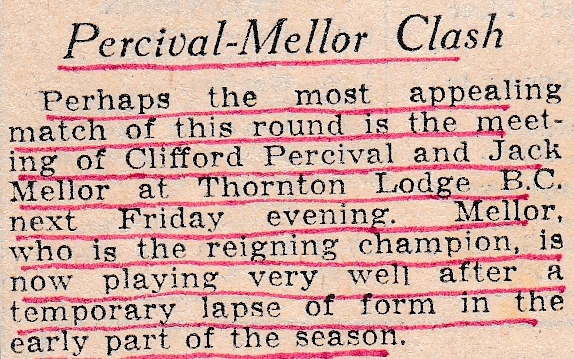
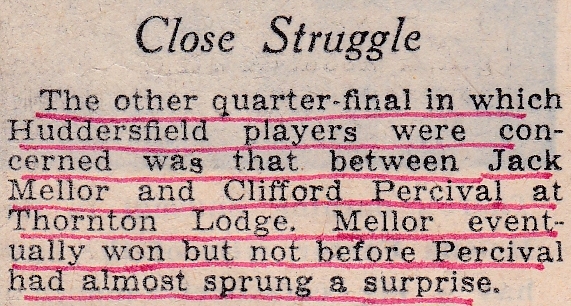
Clifford Percival was Jack’s opponent in the quarter final and the match would take place at Thornton Lodge. Clifford was always thought of as a snooker player but is playing billiards better now than he has done for many years. In the two previous rounds he beat Willie Mills and Harold Burkinshaw who both play for the Huddersfield League team, so he cannot be taken lightly. Jack dominated in the early stages of the match making three breaks over 50 and led 250 – 122 at the interval. Clifford was not finished however and came back with a run of 93 and 59 to take the lead in early 400’s. It seemed as the holder would be beaten but Jack found his touch and compiled a break of 66 and left a double baulk. Clifford only just failed to score from that position and Jack stepped in to get the points necessary for game.
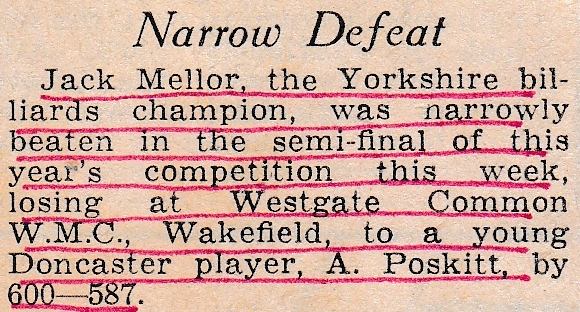
Jack would now meet G. A. Poskitt of Doncaster, who beat Jim Broadhead in his quarter final, and it will the played at Westgate Common W.M.C. Wakefield. Jack couldn’t reach the final for the third year in a row as he was narrowly beaten 587 – 600. Jack led at the interval by 304 – 267 and he increased his lead after the break to 120 but Poskitt fought back and slowly but surely reduced the lead and overtook it at 486. Jack retaliated and was ahead 587 – 551 when he missed a losing hazard in the middle pocket (his favourite shot) and Poskitt stepped in to run to game with a 49 unfinished break. Poskitt lost in the final to Jack Brindley, 1000 – 651, which was his second victory as two years before he beat our Jack.
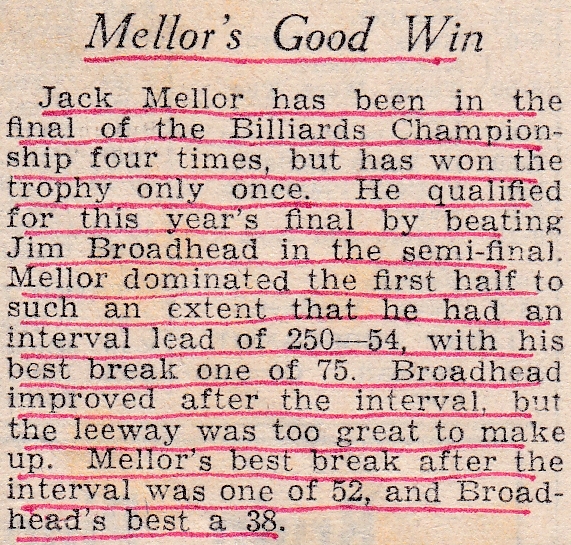
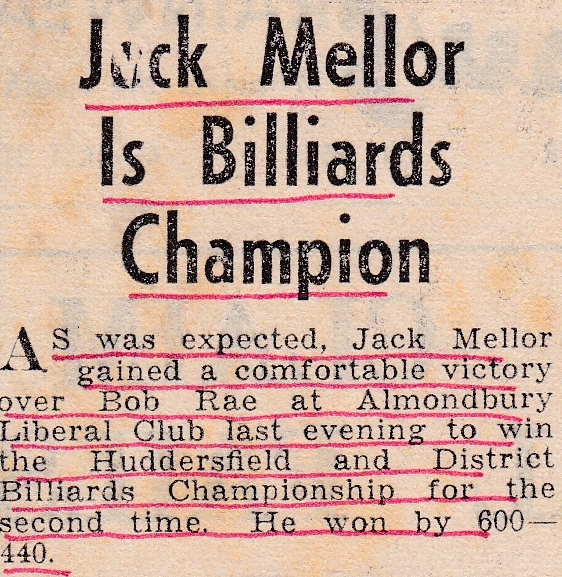
There has been no newspaper reports for the Huddersfield Billiards Championship until January when it says that Jack would have a walk over due to Jack Brindley withdrawing on ill health. It appears that Brindley has not been well for most of the season which could explain why he wasn’t included in the Huddersfield Inter-District League team. In the next round Jack was too good for S. D. Simmonite, winning by 500 – 300 which put him in the semi final against his Rastrick team mate Jim Broadhead. We do not know the final score but Jim didn’t play well up to the interval and basically lost the match when he was 250 -54 behind at that point. Jack, who had been in the final three times before, winning it once, would meet Bob Rae, the Paddock C & BC player, who was knocked out of the Snooker Championship at the semi final stage. The final was not a classic, with the best break only being 88 by Jack which he made before the interval, at which point he led 301 – 200. After a break of 72, Jack had an invincible position of 462 – 242 but Bob fought back with several small breaks before Jack ran out a comfortable winner 600 – 440 and received his second Championship Trophy from Huddersfield Town second team trainer George Richardson.
In the Huddersfield Snooker Championship Jack beat Stanley Broadbent 2 frames to 1 in both home and away legs to go into the quarter-finals, where he faced Ronnie Kershaw. We only know for sure that Jack was losing 2 frames to 1 after the first leg but he must have lost as Ronnie was in the final after beating Jack Firth in the semi-final. A great final was seen when Harold Smith won his first title, beating Ronnie by 3 frames to 2. Ronnie had lost the first two games but fought back to level and in the deciding frame both played well and it was a pity one had to lose.
 Jack Mellor