Life at home must be very settled by now, with Miriam looking after me and my brother while Jack continued playing his hobby – which at times seems more like a job. Fitting in all the competitions he enters must be a difficult task, especially when you consider the lack of communication and transport. I haven’t mentioned this before but Jack fell out of an apple tree when he was young and had to have his left knee fused so he couldn’t bend it. Jack, therefore, couldn’t drive as he was unable to operate the car pedals, and he didn’t have a telephone in his house. The lack of both these things that today we take for granted meant that organising and traveling to games must have been a logistical nightmare. His success on the “boards”, a term used by the Halifax paper, last year, wasn’t as good as the previous year, with him not qualifying for the English Amateur finals. He did win 2 individual trophies and 1 team competition, but it was his play in the Halifax Parish League that was truly outstanding – showing his 6 century breaks.

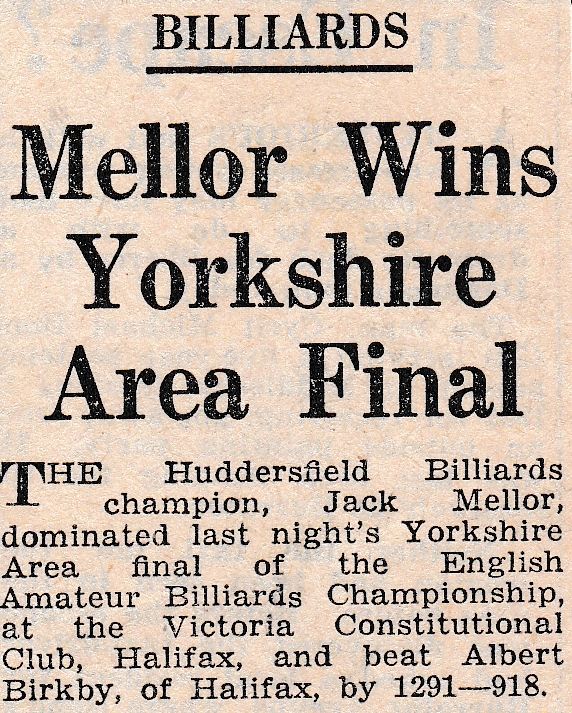
There were only two entries into the Yorkshire Area Amateur English Billiards Championship: Jack and the Halifax player Albert Birkby. The reason for this, I think, is because of the cost involved in playing through the competition proper in London. Cost is something that has been mentioned in previous years, but this year, given there were only the two entrants, you have to think that cost had some major bearing on the competition. Jack and Albert, who have represented Yorkshire in the past two years in the finals proper, will play their game at the Victoria Constitutional Club; a table they are familiar with as both play there in the Parish League. After the first night, Jack led by 528 – 507 but he had not had his own way during the game. There was nothing much between the two up to the interval, with Jack leading 257 -236, but then Albert took the lead with breaks of 88 and 32. Jack stepped in with the biggest break of the night, one of 165, to turn his deficit into a lead of 80, but Albert narrowed the gap before time was called. On the second night Jack scored 394 in the first hour of play at an average of 26 for his 15 visits to the table, while Albert only managed 162. Although Albert’s position was hopeless he never gave up and showed his ability with a run of 107 after Jack had made a break of 120. Jack’s breaks in the match over 30 were 30, 39, 40, 48, 50, 51 twice, 54 twice, 57, 68, 79, 120 and 165. The final score in the match was 1291 – 918, and now he goes on to play in the Championship proper for the third, and last, time in four years.
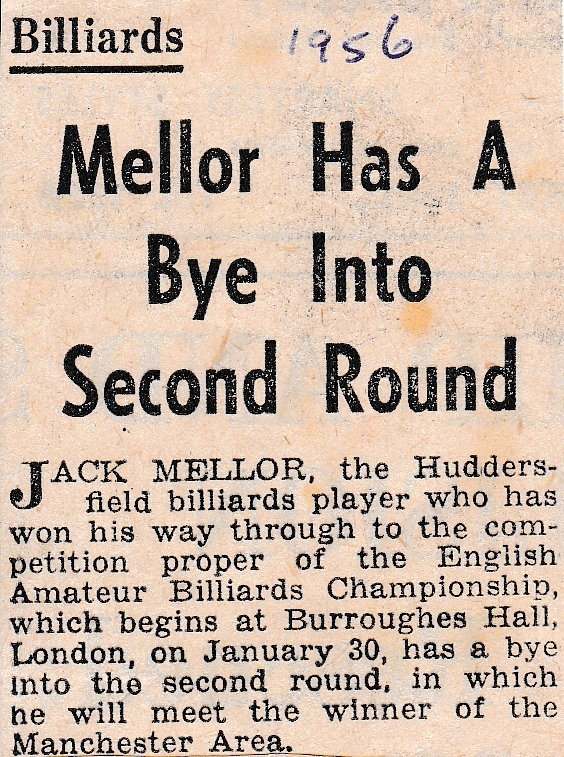
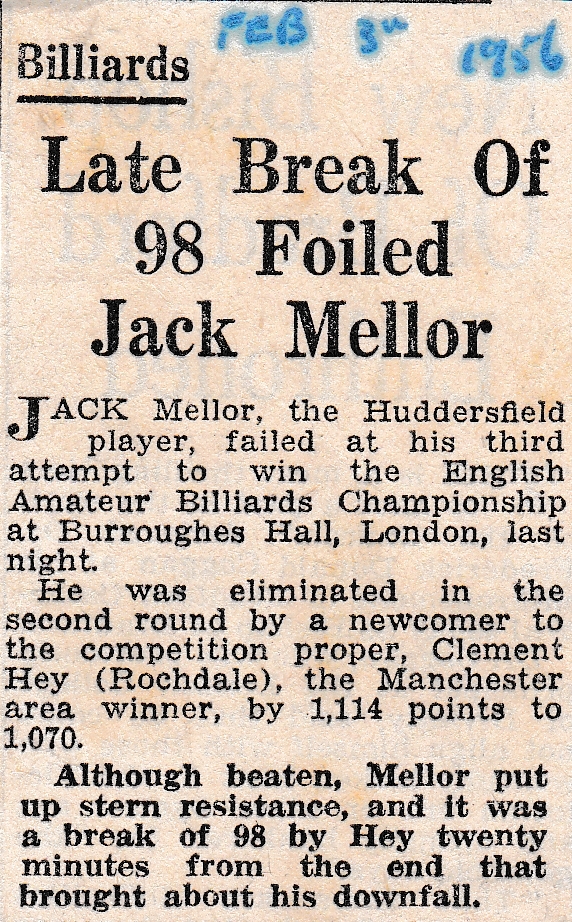
With 18 qualifiers playing in the finals there were only two matches in the first round to get the numbers down to 16 – and Jack had a bye along with 13 others. In the second round he played Clement Hey of Rochdale, who was playing in London for the first time. Jack found break building difficult in the first of the two hour sessions and after an hour he was nearly 200 points in arrears. Hey had flukes in both of his breaks of 82 and 55 and looked as if he would have a handsome lead at the interval. Jack, with typical Yorkshire fighting spirit, suddenly found his touch and demonstrated his real ability. He reduced his deficit with successive breaks of 53 and 65, and twenty minutes from the end of the opening session marked up a splendid run of 108 scoring the last 45 points of the red. At the interval of the second sessions Jack was only 14 points adrift, but Hey extended this to 101 early in the last hour. Jack came back brilliantly with breaks of 67 and 54 to take the lead with fifty minutes left at 867 – 848. Afterwards both player made good breaks, but Hey, with determined play in the last twenty minutes, made a match winning break of 98 to go into the third round. The match finished 1114 – 1070 in Hey’s favour, leaving him to meet the title holder Frank Edwards of Stourbridge. Hey was unfortunate to meet Edwards in glorious form, with six hundred breaks, two of over 200 and one of 300 he ran out an easy winner, 2383 – 604. Edwards went on to win his fifth title beating Leslie Driffield by the closest of margins, 3395 – 3327.
Last year I mentioned that Mrs Myra Armitage played in London in the Women’s Amateur Snooker Championship, and she would be there again this year. She would play Miss Barrett Peckham who beat her last year and went on to win the championship. She had been well coached by Victor Muff, and if she can overcome Miss Peckham she should do well in the later stages. Unfortunately she didn’t beat the holder, losing by three frames to nil, but all three games were decided on the black. Myra was not allowed by the Yorkshire and Humberside Billiards Association to enter the Yorkshire Snooker Championship, but that might later result in the formation of a women’s event.
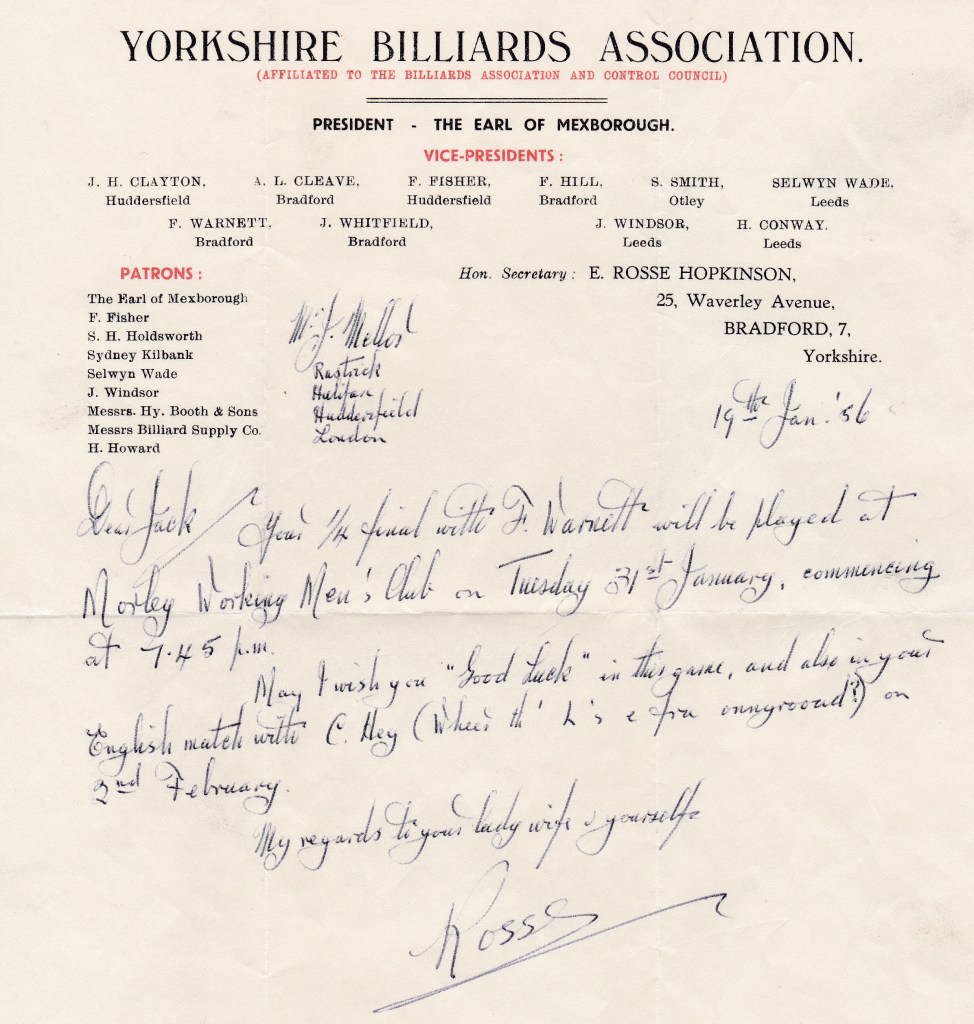
In the first round of the Yorkshire Billiards Championship, Jack gained a lead of 50 in the first half of his match against B. Lawton of Braford and is in front by 400 – 350. We do not have the final score of the match, but he is in the next round draw to play J. H. Lunn of Leeds. Again, we have no score but he narrowly beat Lunn to reach the quarter final where he will meet the winner of A. Poskitt v F. Warnett. Poskitt beat Jack in the semi-final last year so if he got through it seems clear that he will be out to avenge that defeat – a more difficult call than facing Warnett. As we can see from the letter from Rosse Hopkinson, the secretary of the Yorkshire Billiards Association, he would play F. Warnett. As I said earlier, with no telephones, communication was a lot harder than it is today and so the post was used a lot to let people know the details of the matches. Jack must have a good relation with Rosse as he wishes him “Good Luck” for his English Amateur game in London against C. Hey. He even has a little joke by saying in broad Yorkshire “W’heer th’ l’s e fra onyrooad?” and passes on his best regards to Jack’s lady wife.
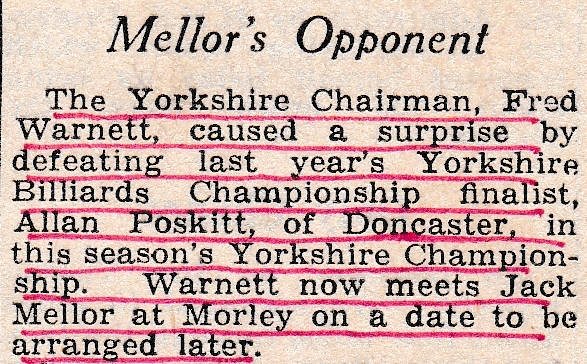
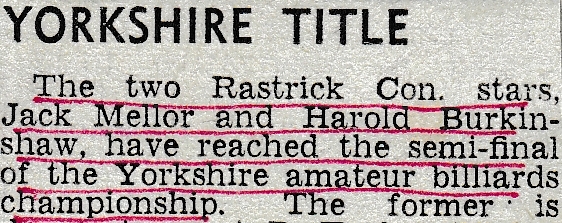
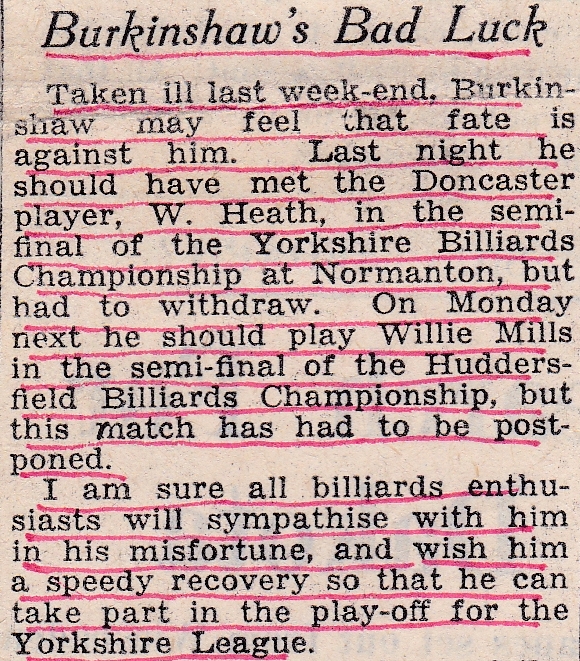
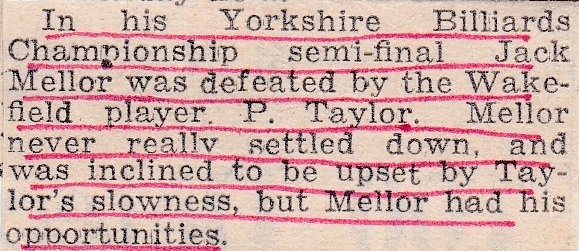
Frank Warnett was one of the Yorkshire Association’s Vice Presidents as a Bradford representative, and sprung a surprise by beating last years finalist, Poskitt. We do not have any score from the match with Warnett but Jack was in the draw for the semi-final and managed to avoid the other Huddersfield player, Harold Burkinshaw, to play P. Taylor of Wakefield, Harold would play W. Heath of Doncaster.

With no reports or scores to give you, I will just share the newspaper clippings that I have about the semi-final games.
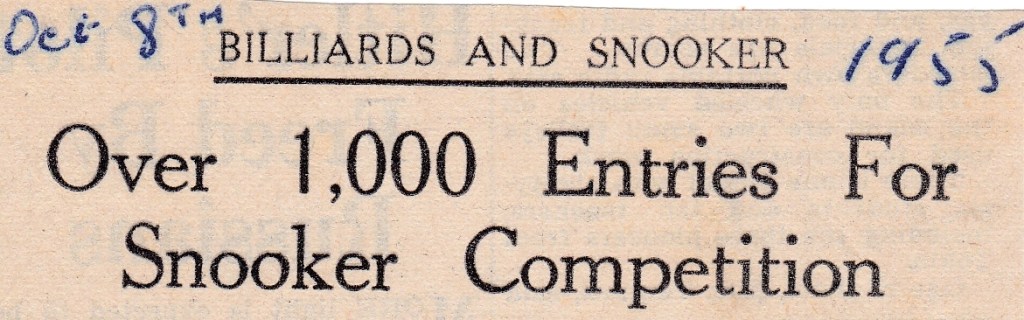
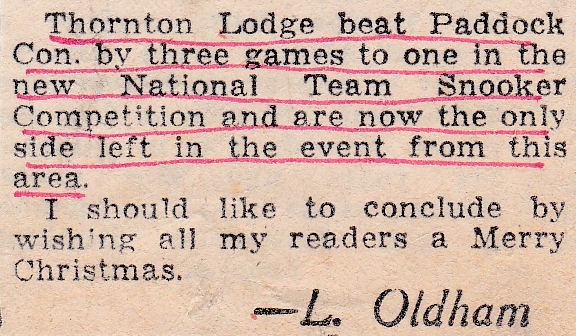
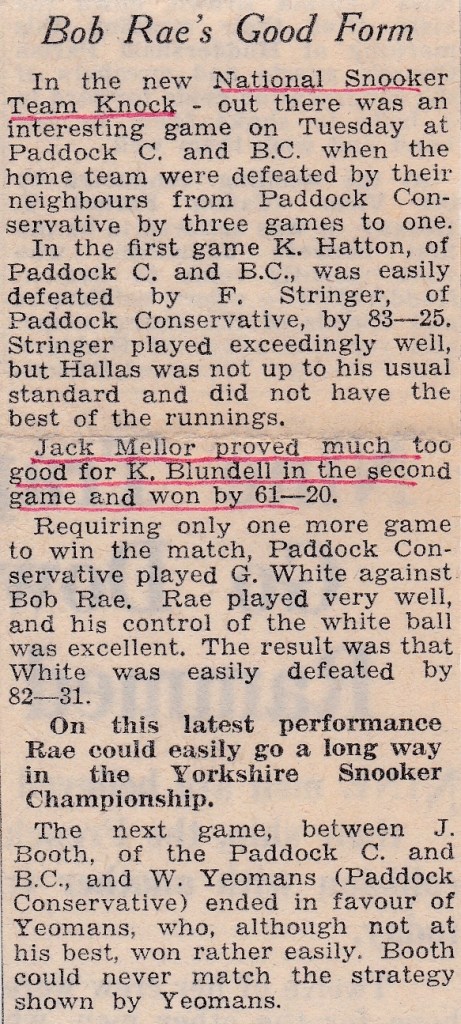
A new National team knock out snooker competition which would be played for this season has attracted over 1000 entrants, 15 from Huddersfield. The prize is the snooker table that Joe Davis made his 146 break on in 1954 and his 147 in 1955, which wasn’t recognised by the B.A. and C.C as a record. The competing clubs are divided into four sections, with the winners going into the semi and final matches in London. Jack will be playing for Paddock Conservative Club and they are drawn against Thornton Lodge W.M.C. No 2 in the first round. We do not know the scores but they played and beat Paddock C & BC in the second round. The Conservative team of Jack, Frank Stringer, Bill Yeoman and Graham White won 3 frames to 1, to go through to the Huddersfield Area semi final. We are not sure who they beat, but we do know they lost in the final to Thornton Lodge W.M.C No 1, by 3 frames to 1. Thornton Lodge lost 3 frames to 1 in the Yorkshire area semi-final to South Leeds Conservative Club, who had home table advantage.
 Jack Mellor