EXAMINER TITBITS DURING THE SEASON
In October there was a report that Leslie Driffield made a break of 744 and Victor Muff, the Huddersfield professional, had 341 in an exhibition match at Roberttown WMC. This was his first exhibition for twelve months, and considering that he was out of practice, showed a very fine effort.
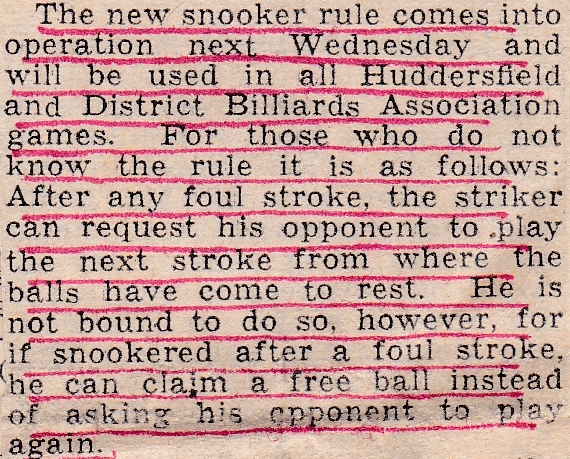
In the first week of February 1958 there was a new rule that came into being for amateur players; one which we take for granted nowadays. It is reported here and relates to what happens after your opponent has made a foul stroke. The professionals had played to this rule for the past seven years and had reported it to be a great success. The difference of rule was the main cause of the split between the Control Council and the professionals, and it is to be hoped that the breach will now be satisfactorily healed.
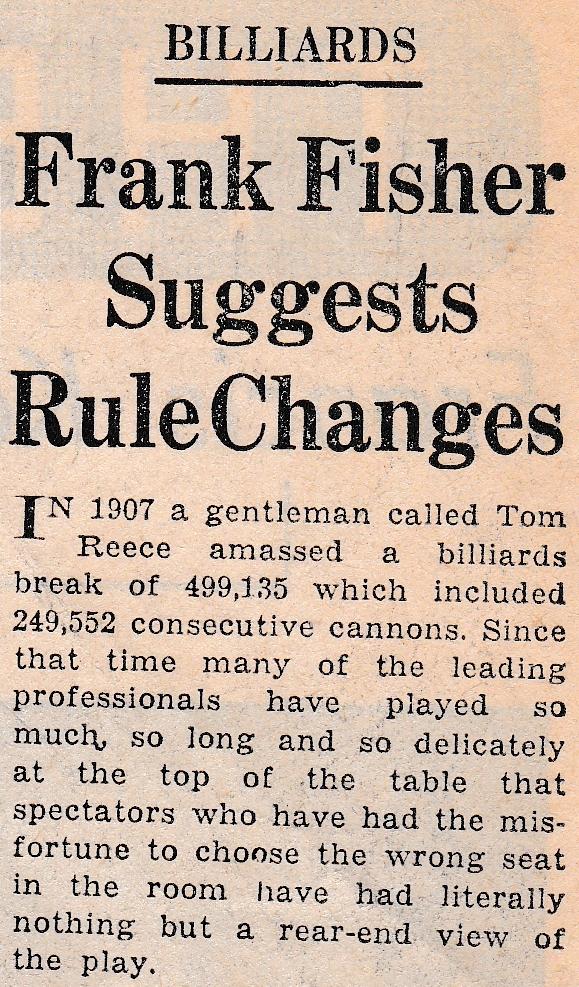
In March there was a very large piece in the paper relating to more proposed rule changes. As you can see here, the piece starts with the story of Tom Reece, who amassed a billiards break of 499,135 which included 249,552 consecutive cannons. Since that time many leading professionals have played so much of the game in such a delicate way at the top of the table, that spectators who have had the misfortune to choose the wrong seat in the room have had literally nothing but a rear-end view of the play. ‘Because of this’, assert many billiards enthusiasts, ‘the game of billiards as a public spectacle was killed – killed by the experts who continued to compile long runs of nursery cannons’. Frank Fisher, of Birkby, is one of these, and because he thinks there is a public call for what he calls the right type of billiards he has put forward to the Yorkshire Billiards Association (of which he is the vice president) suggested changes in various rules of the game. It is suggested that top line players cannot play at the top of the table for too long a spell. He has also suggested “that the crossing of the baulk-line shall be made by a stroke which scores one or more of the last twenty points of each 100 points. The referee shall announce the necessary crossing of the baulk-line when it takes place and shall inform the player when he has scored eighty points of each 100 points made in the course of a break.” He also suggested alterations to the number of times the red can be potted off its spot, from 2 to 5 and the number of hazards, from 25 to 15. Some of these suggestions were approved by the Association and some weren’t but it shows that the game was evolving; hopefully for the better.
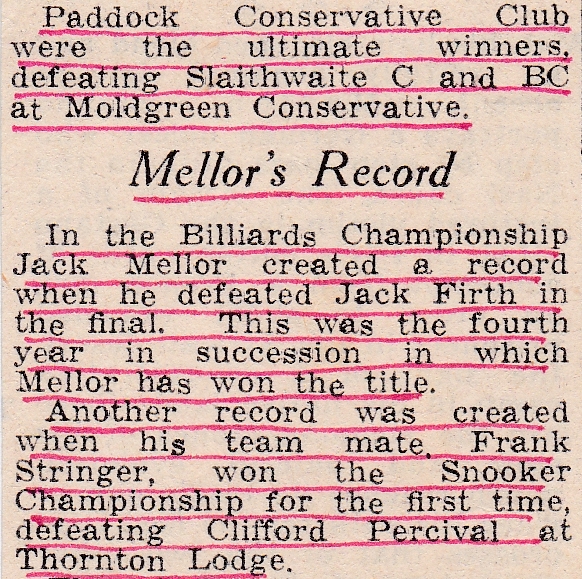
In April when Leonard Oldham gave his end of season report and looked back on what had happened, he mentioned this.
It was a season of many records it seemed. As already mentioned Jack created a record when he won the Billiards Championship for the fourth year in succession. Then Frank Stringer won the Snooker Championship which created a second record, with both players coming from the same club. If that wasn’t enough (and showing something that wasn’t mentioned in any reports), Paddock Conservative Club won the Snooker League. Who was part of the Paddock team? None other than Jack and Frank. They must have had to clear some space on the shelves at the club to make way for all the trophies. I dare say that some beer was drunk at the club, at what must have been one heck of a presentation night that year.

This is a rare photo and probably the only one in existence, as it shows three trophies won by players of the same club, Paddock Conservative Club. Jack won the Huddersfield Billiards Championship on the left, Frank Stringer won the Huddersfield Snooker Championship in the centre and the right hand trophy is the Snooker League Trophy. It’s a shame that the hero of the League final, Bill Yeoman, is not in the photo.
 Jack Mellor