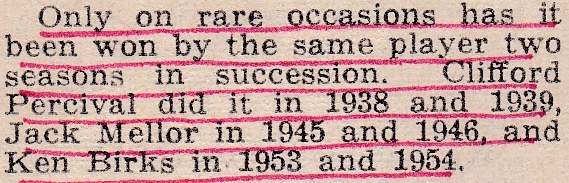
I think the lack of reports for this period tells it’s own story: a very poor season for Jack. There could be many reasons for that. I can remember Mum being very poorly around this time, and so it seems fair that Jack’s home life would play a part in his wellbeing and confidence. As has always been the case, and always will be the case, personal life and individual circumstance can have a hugely adverse effect on someone’s ability to be or play at their best. Jack only had one break of note that we know of, 125 in the Yorkshire Billiards Championship, and one championship title. Winning the Snooker Championship for the last time in his career was a record in itself, showing as the longest time between championship wins, 1946 to 1961 – 15 years – and proof that there was life in the old dog yet.
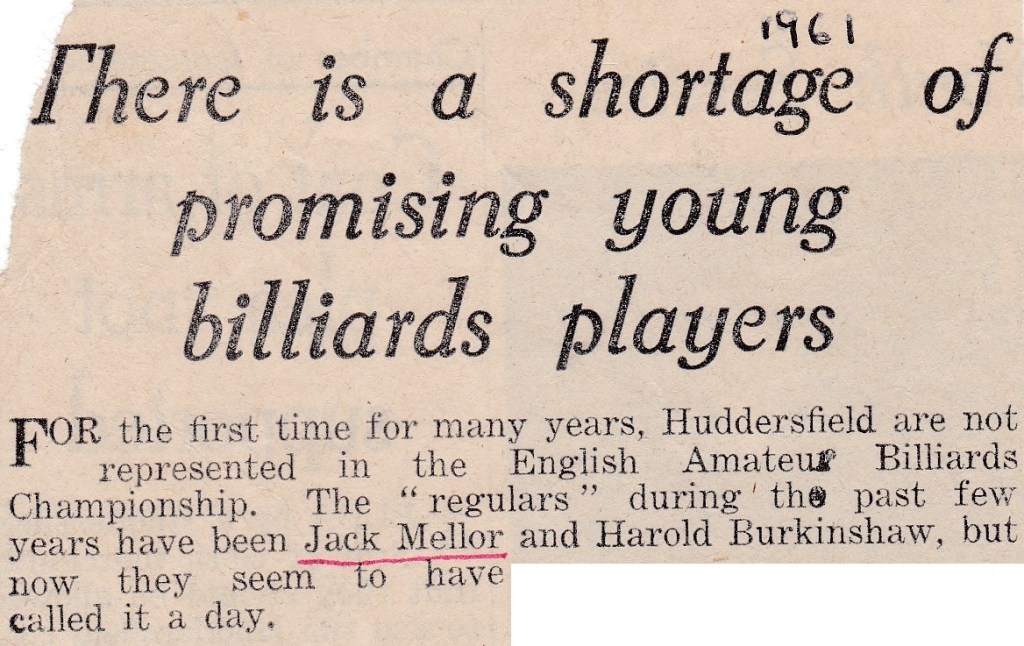
This was the headline when it was reported that, once again, there is no Huddersfield player entered into the English Amateur Billiards Championship. It was the same two years ago, and backs up what I’ve said about Jack, as Harold did enter the competition last year. One reason is the gulf between the top class amateurs and the average club player, but the main stumbling block would seem to be money. Not everyone is in a position to be able to pay for their own expenses should they be lucky (or unlucky, as the case may be) to play in the competition proper in London. A solution for the latter could be to take the finals out of London and play them in various districts around the country. Having said that, there is still a shortage of young players, with last year’s Yorkshire Champion Peter Tasker of Halifax having gone on to represent Yorkshire in the finals proper and become the youngest player to achieve this feat.

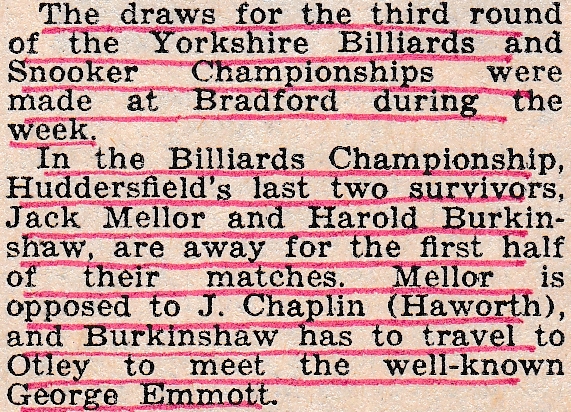
In the Yorkshire Billiards Championship, Jack played S. H. Smith of Firth Park WMC, Sheffield and went through to the next round when, in the away leg, he ran out with a 149 unfinished break. Jack now meets Clifford Percival in the second round, just as they had done last year when Jack was the winner. No reports of this game, but Jack goes through to the third round where he would play J. Chaplin of Howarth – who has home table advantage first. Jack’s break of 149 was the highest break of the competition up to that point.
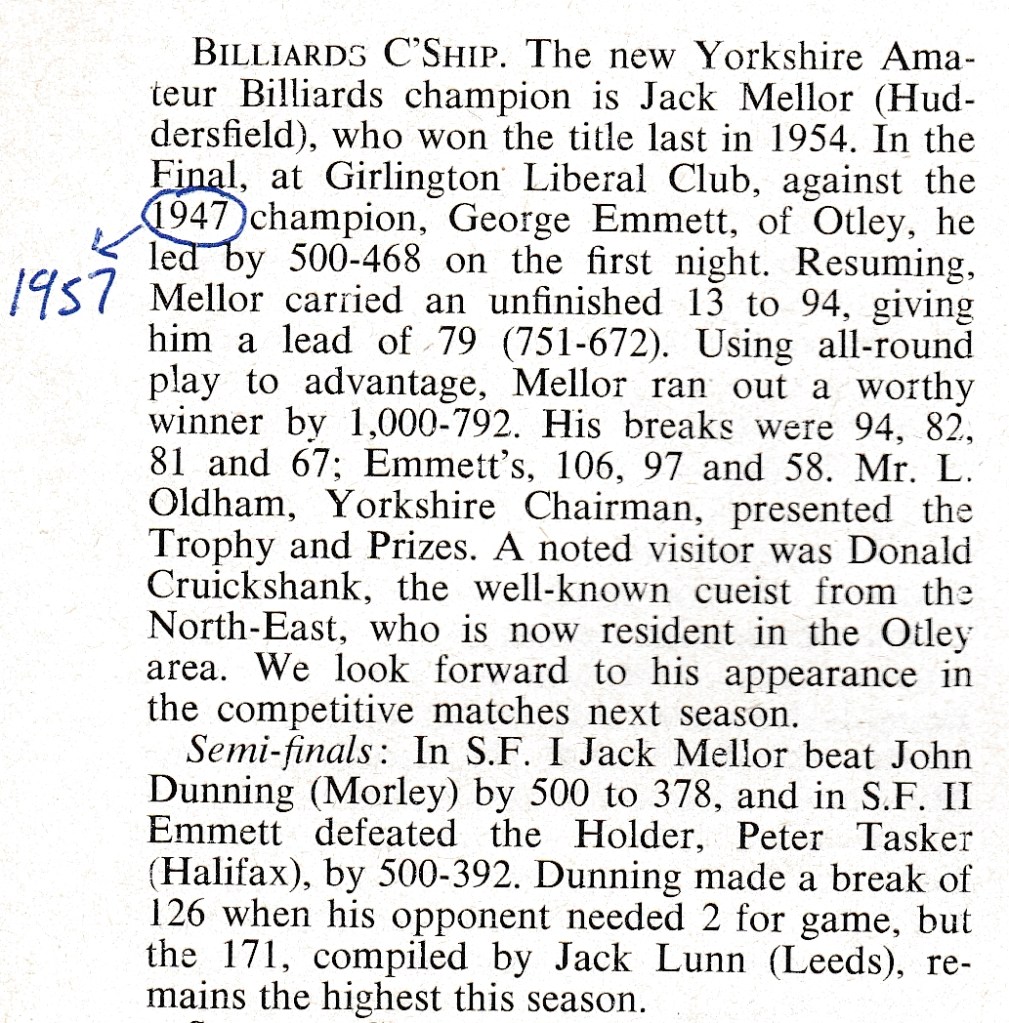
There hasn’t been a single report of the Yorkshire Billiards Championship which, considering how many we have had, is strange. So at the end of the year I do not know if he beat Chaplin – and if he did, who else he might have played. I had given up on this until I came across a report in next years selection, that says he is the holder. With this, I looked in the Billiards and Snooker magazine to see what I could find, and here it is. Jack beat Chaplin and then John Dunning in the semi-final, in which he was leading 498 – 252 until Dunning had a break of 126 – a great achievement, but one that proved too little, too late. Jack didn’t end up with the highest break as Jack Lunn’s 171 was the highest. Jack, in his meticulous fashion, has corrected the report from when Emmott won the Championship. This diary is made up of what Jack left me and therefore has gaps in it – which I’m ok with – but to not have a single report of his second Yorkshire Title doesn’t sit easy with me. When the Covid-19 restrictions are over and the Library is open, I am going to visit to find the reports and add them to this diary.
The Billiards and Snooker magazine was called the Billiard Player, which I’ve referred to before, but it changed its name in January 1961. As the Editorial here explains, it was reverting back to it’s original name, which it had up to 1938.

The only reports of the Huddersfield Billiards Championship are these two from the final. We do not know any of Jack’s opponents as he went on to win his sixth title. The final was played at Marsh United Bowling Club against Clifford Percival, who he had beaten in the Yorkshire Billiards Championship earlier that season. The first night saw Clifford get off to a good start with breaks of 31, 19 and 22 led by 144 -118, but Jack then made the nights highest break of 87 to lead 205 – 144. Clifford never really had a chance to get going again, as Jack had further breaks of 54, 30 and 29, to lead at the halfway stage by 350 – 159.

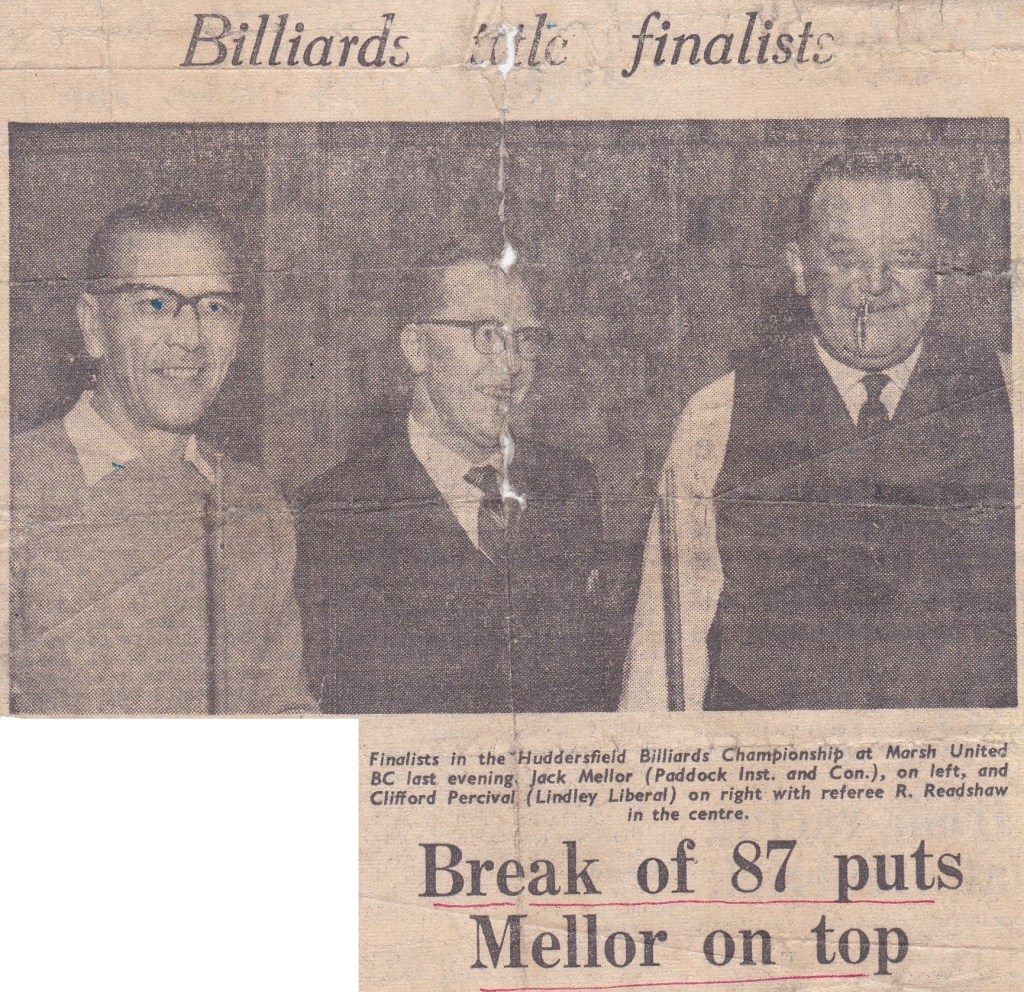
Clifford reduced the lead of 191 with breaks of 45 and 32 to just 69 at 403 – 334, but Jack answered with breaks of 33, 31 and 29 to lead by 551 – 406. Any hopes that Clifford had evaporated when Jack, with domination of the red ball, ran up a break of 136 to get him to just 9 away from victory. Clifford immediately produced his highest break of the final, one of 47, before Jack reached the 700 mark. Jack only needs one more success to equal the record that Victor Muff holds – the man who, in fact, who presented the trophies on the night. Just as with the Yorkshire Title, I can’t let Jack’s victory go without knowing a bit more about how he got to the final, so watch this space. And lastly, I promise you, it wasn’t me that coloured Jack’s eyes in on the photograph above.
How disappointing that we have no reports of the Huddersfield Snooker Championship, as I’m sure Jack would have defended his title. I need to do a lot of research when I’m allowed. As we know from the handbook, he didn’t win it – Tommy Donlan won his first, and went on to win it again over three consecutive years. It would be another forty years before Robert Read broke that record.
 Jack Mellor