This story is coming to an end, with the lack of newspaper reports left by Jack cutting our story short. Jack is still capable of producing some fine play, and is still winning games and trophies, but his appetite to cut out and save reports seems to be dwindling. It’s at this time that I feel so disappointed with myself for not engaging with him more when he was here. He surely had so many stories to tell, and I should have been more interested in what he achieved so that I could have relayed them more thoroughly to you, the reader. Alas, I wasn’t and so we have to make do with the few remaining reports he did leave and be happy with that. So, last year Jack won his second Yorkshire title along with his sixth Huddersfield title, and made three century breaks (that we know of). There were probably more big breaks and other stories, but with no reports we can only guess.
There is a change to the English Amateur Snooker Championship this year, as announced in May by the Billiards Association & Control Council, and detailed in the Billiard and Snooker magazine in September. There will be a Northern Area Champion – the final played at Leeds City Transport Employees’ Club – and a Southern Area Champion, the final to be played at Burroughes Hall, London. The two winners will meet for the English title in a final to be played at the Tower Circus, Blackpool. There is no change to the Billiards competition at this moment in time.
This season, Harold Burkinshaw had entered the English Amateur Billiards Championship and will play J. H. Lunn. The other two entrants are Leslie Driffield and Lord Mexborough. Harold beat Lunn, 1275 – 902, and Leslie beat the Earl, 2144 – 339, so meet in the Area Final. Leslie Driffield is the holder and seven times Champion, and Harold had a difficult task on his hands. The unexpected is of course possible, as demonstrated some years ago when Jack Bindley defeated Leslie in the Yorkshire Championship just after Leslie had won the World title. Unfortunately, on this occasion the unexpected didn’t happen and Harold lost heavily, 1933 – 390, with Leslie making breaks of 183, 141, 104, 191, 159, 131 and 186 – proving once and for all why he was the reigning Champion.
Jack starts his defence of the Yorkshire Billiards Championship with a first round game against the Hungarian player Geza Gazderg, who had played against Harold Burkinshaw in last years Yorkshire League game for Bradford. Jack had a lead of 400 – 338 after the first away leg, despite Gazderg having the highest break of the night – one of 92. Most of his points came from cannons, which he is a top class exponent of. Jack progressed into the last eight by winning the second home leg by 400 – 146, which included a break of 101, and so won the match by 800 – 484.

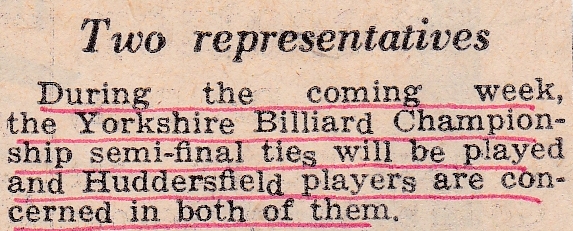
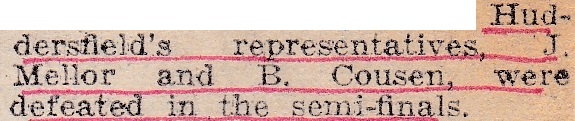
Jack was away in the first leg of the quarter final against F. H. Almond of Sheffield, but we do not have any reports of the score. All we know is that he won and was in the draw for the semi-final. There he meets Donald Cruikshank who he has played twice in Yorkshire League games this season – with the honours even – so it should be a great attraction. Unfortunately we have no reports of the match, but Jack lost and Cruikshank went on to win the competition; beating John Dunning in a one sided final by 1000 – 448. Cruikshank had four century breaks in the final which was a record. Dunning had beaten Brian Cousen in the other semi-final.
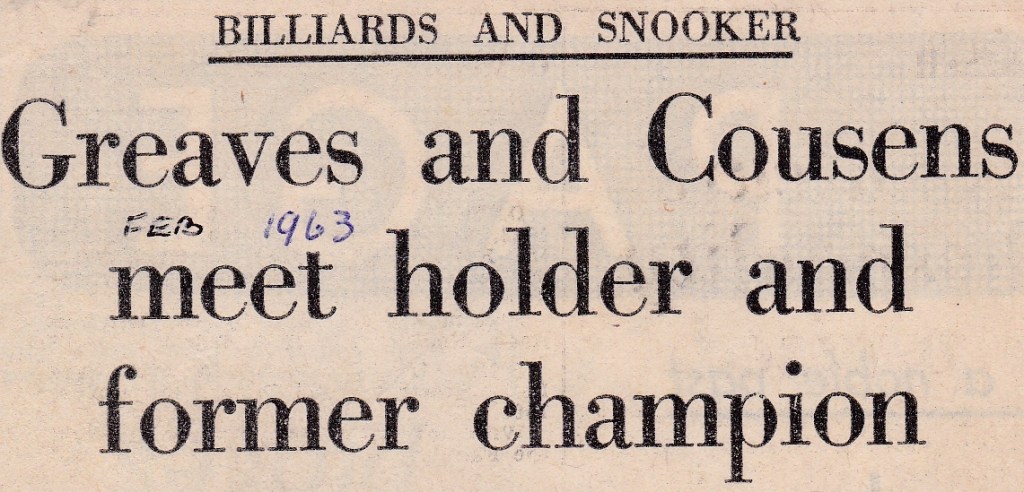
It is February before we have a report of Jack’s defence of the Huddersfield Billiards Championship, and it’s the announcement of the semi-final draw where he would play George Greaves at Longwood Conservative Club. It is the first time that Greave’s, of Golcar Conservative Club, had reached the last four. The other semi-final had the young Brian Cousen playing the older and more experienced Harold Burkinshaw at Marsh United Bowling Club. Brian, like his opponent, is from Lindley Liberal Club, and had lost at this stage last year.
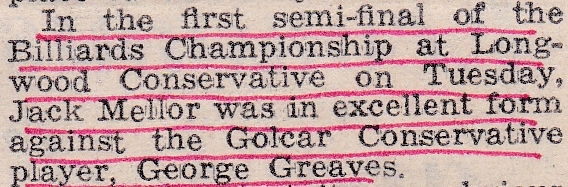
In the first semi-final, George Greaves was no match for Jack and at the interval was 200 – 16 behind. Jack didn’t give George many opportunities, with breaks of 38, 70 and 47, and it seems that it was always going to be Jack‘s night. In the second half George did have a break of 40, but Jack ran out an easy winner, 400 – 108 to reach his tenth final. It was unfortunate that Greaves, in his first semi-final, should meet Jack in such devastating form.
In the other semi-final it was a classic case of pupil defeats teacher, as the young Brian Cousen beat the older Harold Burkinshaw by 400 – 286, with very consistent play, to reach his first final. The final would be played at Thornton Lodge Bowling Club and it promised to be very interesting and entertaining judging by the performances of both players in the semi-finals. There was little to choose between them, with Jack having a small lead of 201 – 173 at the interval as he had a break of 80 and Brian one of 43. After the interval, Brian slowly overhauled Jack and would start the second night with a small lead, 351 – 332. At the start of the second night, Brian was in hand with a break of 29, but could only add 3 to that. Jack, aided by breaks of 60, 51 and 32, led 600 – 472. Brian did have breaks of 22, 32 and 54 to narrow the gap but with a further break of 41, Jack won his seventh title. That equalled the record of Victor Muff, who was the first to achieve this particular feat.
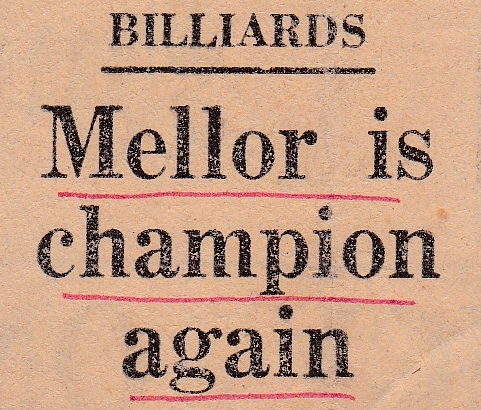
 Jack Mellor